
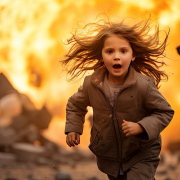
How to respond to this question increasingly asked by concerned family members?
In the current global situation, with 190 armed conflicts ongoing and thousands dead or wounded worldwide (you can see detailed data HERE in a study published under the UCDP conflict research program), it’s not easy to provide an answer that won’t cause panic or depression. Due to the overwhelming wave of bad news, people are becoming more anxious and are starting to ask themselves and their families a key question – what should we do if the worst happens?
Although daily sensationalist news often turns out to be false, and the media frequently predicts the end of the world (if not from war, then from storms, disease, or some other disaster), which we somehow manage to survive – we should never underestimate human stupidity and destructiveness. Therefore, without panic, we should consider potential dangers and do everything we can to reduce the impact of crisis situations. Most importantly – try to follow information from reliable sources, without sensationalism or planted fake news. You can read more about that HERE.
As for war, unfortunately, we have experience and don’t need anyone to explain how people are capable of the worst atrocities (a term that is, at times, actually insulting to animals). Still, aside from the immediate danger of war, there are many associated risks such as disruptions in the supply of food, energy, transportation issues, and similar problems that affect millions of people.
It is also clear that in wartime conflicts, targets are not chosen carefully – civilians are deliberately and massively killed, and civilian infrastructure is destroyed. That too must be taken into account when planning protective measures.
As always in worst-case scenarios, important decisions must be made quickly: Should we stay or leave? When and where should we evacuate the children? Do we have enough food and water? These are questions we must prepare for in advance – assess the risks, agree on details within the family, and ensure we avoid creating panic, especially when informing children about such topics in an age-appropriate way.
> MILITARY SERVICE
One way to protect ourselves in wartime circumstances is to take up arms and defend ourselves. It’s clear that no sane person wants to send their children to “learn how to kill,” but we’re happy to send them to a self-defense course in case they are attacked. So it should be clear that military service can also be useful – if it is organized properly.
All of us who served in the military in the former state often considered our time in the Yugoslav People’s Army (JNA) as the most useless part of our lives, convinced we had learned nothing of value. However, as outdated and mentally numbing as the training was, we were wrong. Some of the skills we learned later helped us aid people in distress and defend ourselves against aggression.
Still, it’s important to understand that assessing the safety of your family isn’t only about worst-case war scenarios.
> COTTAGE / HOLIDAY HOME
After the pandemic and earthquakes, it became clear that a weekend house, coastal cottage, or family home in the countryside can serve as a practical shelter for a few days during a crisis. Thinking about having enough food and drinking water at such locations isn’t just a concern for preppers or those expecting doomsday. Talk to your family and friends about alternative accommodation options if you don’t have one of your own.
> SUPPLY
You can read more on our website about the challenges of supply chains in crisis situations. Many well-organized Western countries have detailed guidelines for citizens – how to prepare for survival in emergencies, including wartime conditions. Consider creating a small stockpile of food and water for a few days.
> TRANSPORT
In crisis situations, make sure you have a full fuel tank in case evacuation becomes necessary, stay up to date on traffic conditions (via HAK info, mobile traffic apps), and prepare a bag with essential gear. You can read more about this HERE.
> INFORMATION AND COMMUNICATION
Real-time information about a crisis is essential for making decisions. Today, modern systems provide information not only through the internet, radio, and TV, but also via a wide variety of mobile apps – it’s important to test these and learn how to use them.
Of course, don’t forget about potential problems with mobile network availability or internet access. Be ready to rely on a radio receiver – even amateur (HAM) radios – for critical information.
> SHELTERS
During the Homeland War, we learned the importance of shelters. It’s a good idea to check with local authorities where the shelters are located, what condition they’re in, or what you can do to improve protective measures in your own home. It’s also an opportunity to evaluate your home’s safety not just for wartime, but for other disasters such as natural catastrophes, fires, floods, lightning strikes, or access for emergency vehicles.
It’s also wise to read up on survival equipment and procedures – there are plenty of resources available online, including on our own website HERE.
In any case, whatever happens – don’t panic. Prepare reasonably and according to your capabilities, keeping in mind that the worst may never come.
(Illustration: Freepik)